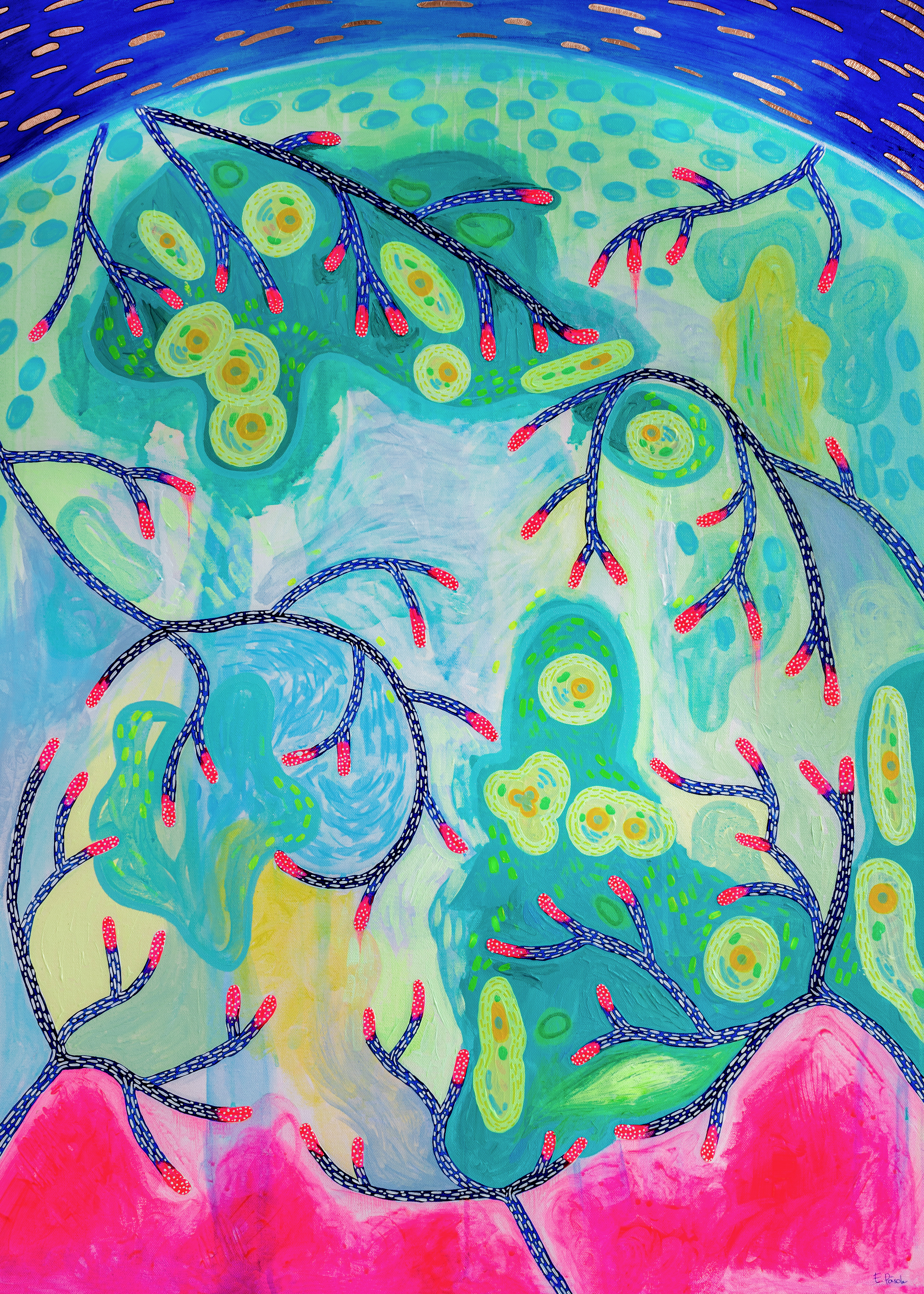
Pulse of Protection
Acrylic on canvas, copper foil and fluorescent & copper foil details
76 × 101 cm
Private collection
Acrylic on canvas, copper foil and fluorescent & copper foil details
76 × 101 cm
Private collection
2026
ArtEvol 2026: A View from Everywhere — Longlisted, London Art Collective / Saatchi Gallery, London
Pulse of Protection
ArtEvol 2026: A View from Everywhere — Longlisted, London Art Collective / Saatchi Gallery, London
Pulse of Protection
Tree branches like blood vessels. Corals becoming neurons. Roots, synapses and capillaries repeating versions of the same structures at radically different scales.
These visual rhymes make the boundaries between the human body and the landscape feel more fluid. Pulse of Protection explores this shifting ecosystem through the macro and the micro.
My fascination with this hidden world began long before I started painting it. As a child, I loved exploring my grandmother’s laboratory, where she worked as a cytologist. I can still instantly recall the smell of the antiseptic, hear the click of the microscope changing lenses and see her white coat gently dancing around the room. Under magnification those glass slides, stained in blues, cyan and magenta transformed into vivid landscapes. I learned all about the differences in their structures and listened to my grandmother explain how abnormal cells can reveal changes taking place inside an otherwise healthy-looking person.
Years later that childhood fascination became personal. Living with an autoimmune condition changed the way I understood the invisible body. From the outside, a person can appear healthy and energetic while complex and sometimes painful processes are unfolding beneath the surface. The immune system is supposed to protect us, but an autoimmune disease confuses it, and the body becomes a battleground.
Pulse of Protection tries to make sense of this contradiction. Cells drawn from medical references morph into forms that can look like corals, blood vessels, plants or synapses. An unfinished spiral moves through the composition, structures approach one another, close to touching, tiny red traces appear among the bright forms - all those little signs that life is continually flowing in ways we neither anticipate nor control.
The materials carry this idea further. Acrylic and fluorescent pigments produce an almost electrical intensity; the painting seems to buzz and tingle. Copper, well-known for its antimicrobial properties, catches the light across an arc that can suggest a Petri dish, a microscopic field or a long-exposure starry sky. Under blue lights, the painting reveals a whole new glowing layer, shifting the perspective.
The brightness of the colours, however, does not describe how I feel while painting; I have noticed the opposite pattern. During periods of exhaustion or low mood, I reach for my most intense colours. Fluorescent pinks, cyan and electric greens become direction rather than description - where I’d like to be. It’s a movement towards energy, playfulness and aliveness. For me, optimism is not passive - choosing brightness is an act of defiance.
At first, Pulse of Protection looks like a blast of colour and movement - but if the viewer stays with it for longer, it will gradually reveal the hidden world. Their attention will turn inward, away from the relentless hustle of today and towards the extraordinary systems - rainforests, synapses, coral reefs, blood vessels - underlining our inevitable interconnectedness.